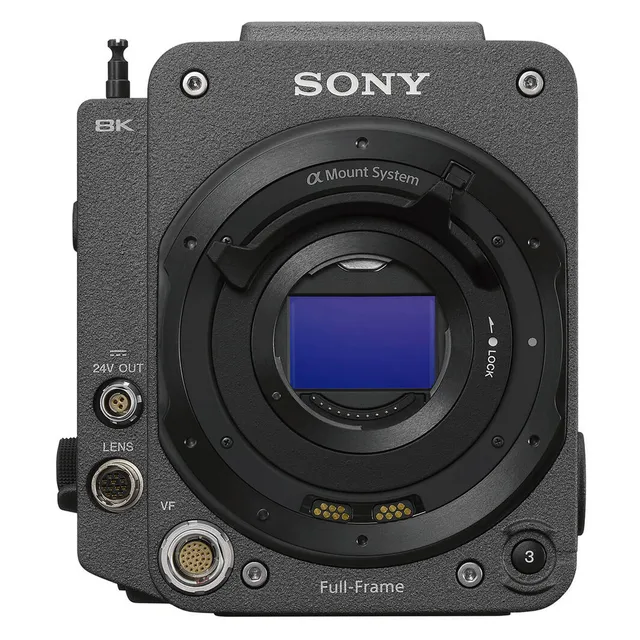
Technical specifications
- Sensor
- Full-Frame CMOS
- Sensor Size
- 36.2 x 24.1 mm
- Megapixels
- 49.76
- Mount
- Sony E
- Max Resolution
- 6K (8640x5760)
- Max Frame Rate
- 90fps @ 5K
- Codec
- ProRes
- Dynamic Range
- 16 Stops
- ISO Range
- ISO 200–12800
- ND Filter
- 1–8 stop (8-position wheel)
- Ports
- 4x BNC (12G-SDI), 1x BNC (HD-SDI), 1x HDMI, 1x 1/8" / 3.5 mm TRS Stereo Headphone, 1x XLR 5-Pin Mic/Line/AES/EBU Selectable, 1x XLR 4-Pin (12 to 32VDC), 1x Proprietary, 1x LEMO 2-Pin (12VDC), 1x Fischer 3-Pin (12VDC), 1x 26-Pin Viewfinder, 1x BNC (Timecode), 1x BNC (Genlock), 1x BNC (Timecode), 1x Hirose 8-Pin Control, 1x Lens 12-Pin Control, 1x RJ45 (Ethernet)
- Weight
- 4300g
- Dimensions
- 249.94 x 157.99 x 151.89 mm
- Released
- 2022
Add your voice
Your ratings help other filmmakers choose the right camera.
Own it?
What do you use this for?
Field guide
Overview
The Sony VENICE 2 is a powerhouse of a digital motion picture camera, designed to be the ultimate workhorse for high-end cinema and broadcast productions. It is a modular, full-frame system that offers cinematographers the choice between two interchangeable sensor blocks: the 8.6K MPC-3628 for maximum resolution and VFX flexibility, or the 6K MPC-3626, which is the same sensor found in the original VENICE. It competes directly with the highest-tier cinema cameras on the market, offering a robust magnesium alloy chassis that is built to survive the rigors of professional sets while remaining surprisingly compact for its class.
What sets the VENICE 2 apart is its incredible latitude—16 stops on the 8.6K sensor and 15+ stops on the 6K—and its Dual Base ISO capabilities, which allow for clean, low-noise images in both bright sunlight and challenging low-light environments. The camera also features an 8-position internal optical ND filter system, which is a massive time-saver on set, and supports 16-bit X-OCN or 4K ProRes recording directly to AXS memory cards. The modular design, including the ability to extend the imager block on the 6K model, makes it an incredibly versatile tool for everything from handheld work to drone cinematography.
This camera is built for professional cinematographers and production houses working on feature films, high-end episodic television, and demanding commercial projects. If you need a camera that can handle extreme dynamic range, offers a wide color space exceeding DCI-P3, and provides a familiar, intuitive menu system that can be accessed from both sides of the camera, the VENICE 2 is a top-tier choice.
Pros & Cons
Pros
8-position internal optical ND filter (0.3 to 2.4ND) saves significant time on set by eliminating the need for external filters.
Interchangeable sensor blocks (8.6K or 6K) provide flexibility for different production needs without requiring a new camera body.
Dual Base ISO (MPC-3628: 800/3200; MPC-3626: 500/2500) allows for excellent low-light performance while maintaining dynamic range.
16-bit X-OCN recording provides a high-quality, manageable raw workflow that is native to many NLEs.
Modular design with an intuitive menu system accessible from both the Assistant and Operator sides of the camera.
Cons
Full-Frame and Anamorphic shooting modes require additional software licenses, increasing the total cost of ownership.
High-resolution 8.6K recording is limited to specific frame rates and requires high-speed S66 AXS memory cards for certain formats.
The camera is heavy and requires a robust support system, which may be challenging for some run-and-gun configurations.
The internal fan and battery are consumable parts that require periodic professional maintenance after approximately 5 years.
The camera requires specific, high-capacity AXS memory cards, which are a significant additional investment compared to standard media.
Best Settings
Narrative Filmmaking
Use the 8.6K 3:2 imager mode for maximum resolution and flexibility in post-production. Record in 16-bit X-OCN XT to preserve the full 16 stops of latitude for grading. Set the Base ISO to 800 for controlled lighting environments.
Documentary / Run-and-Gun
Use the 5.8K 17:9 or 5.4K 16:9 mode to balance resolution and file size. Utilize the internal 8-position ND filter to quickly adjust to changing light. Set the Base ISO to 800 or 3200 depending on the environment. Use X-OCN ST for a balance of quality and storage efficiency.
Interview & Talking Head
Use the 6K or 5.7K 16:9 mode for a clean 4K oversampled output. Set the Base ISO to 500 or 800. Use a standard 180-degree shutter angle for natural motion blur. Record in 4K ProRes 422 HQ for a fast, high-quality turnaround.
Slow Motion
For the 8.6K sensor, use X-OCN at up to 90 FPS. For the 6K sensor, use X-OCN at up to 120 FPS. Note that higher frame rates may require specific AXS card types (S66) and may have limitations on recording formats.
Common Issues
Media Full Error
What's happening: Recording stops unexpectedly. Why: The AXS memory card has reached its capacity. Fix: Replace the card with one that has sufficient space. You can monitor remaining time on the sub display. Prevention: Set the 'Media Near Full Alarm' in the Technical > Alerts & Tally menu to receive warnings before the card is full.
High Temperature Warning
What's happening: A thermometer icon appears on the screen. Why: The internal temperature has reached 65°C (149°F). Fix: Turn off the unit and allow it to cool down before resuming operation. Prevention: Ensure the air inlets are not blocked and the fan is set to an appropriate mode in the Technical > System Configuration menu.
Formatting Fails
What's happening: The camera cannot format an AXS or SD card. Why: The card may be write-protected or using an unsupported file system. Fix: Check the write-protect switch on the card. If it persists, try formatting the card in another device or replacing it. Prevention: Always use the camera's internal format function to prepare cards for use.
No Audio Input
What's happening: No audio is being recorded. Why: The AUDIO IN switch may be set incorrectly for the connected source. Fix: Check the AUDIO IN switch (LINE/AES/EBU/MIC) and ensure the correct input channel is selected in the Audio menu. Prevention: Verify audio levels on the sub display meters before starting a take.
FAQ
- Can the Sony VENICE 2 shoot 4K at 120fps?
Yes, the 6K image sensor (MPC-3626) can record X-OCN at frame rates up to 120 FPS. The 8.6K image sensor (MPC-3628) is limited to 90 FPS.
- What memory cards does the Sony VENICE 2 use?
The VENICE 2 uses Sony AXS memory cards. Supported cards include the S24, S48, and S66 series, depending on the recording format and frame rate.
- Does the Sony VENICE 2 have built-in ND filters?
Yes, the VENICE 2 features an 8-position internal optical ND filter system, offering a range from 0.3ND (1 stop) to 2.4ND (8 stops).
- Are the sensors in the Sony VENICE 2 interchangeable?
Yes, the 8.6K and 6K image sensors are interchangeable. The camera body is designed to allow the user to swap these imager blocks.
- What is the Dual Base ISO of the Sony VENICE 2?
The MPC-3628 (8.6K) has a Dual Base ISO of 800 and 3200. The MPC-3626 (6K) has a Dual Base ISO of 500 and 2500.
- Does the Sony VENICE 2 require licenses for all features?
No, but Full-Frame and Anamorphic shooting modes require optional software licenses that must be purchased separately.
- Can I use E-mount lenses on the Sony VENICE 2?
Yes, the camera comes with a PL lens mount, but it can be removed to support E-mount lenses.
- How do I update the firmware on the Sony VENICE 2?
Firmware updates are performed via the Maintenance > Firmware menu. You will need to load the update file onto the camera.
Recommended Accessories
- ARRI LMB 4x5 Matte Box — professional filter solution for precise light control. Shop on Amazon
- OConnor 2575D Fluid Head — industry-standard support for heavy cinema builds. Shop on Amazon
- Teradek Bolt 6 LT 750 — reliable wireless video transmission for client monitors. Shop on Amazon
- Cooke S7/i Full Frame Primes — premium lenses for cinematic full-frame look. Shop on Amazon
- DVF-EL200 Viewfinder — high-resolution OLED viewfinder for precise monitoring. Shop on Amazon
- AXS-A1TS48 AXS Memory Card — high-capacity, high-speed media for 6K recording. Shop on Amazon
- Wooden Camera VENICE 2 Cage — modular cage system for robust accessory mounting. Shop on Amazon
- Sony E-Mount to PL Adapter — adapts professional PL lenses to the native E-mount. Shop on Amazon
Related comparisons
The Burano excels for agile, solo operation with IBIS and AF; the VENICE 2 remains the gold standard for high-end, controlled cinema productions.
See full comparison VENICE 2 vs ALEXA Mini LFThe ARRI ALEXA Mini LF delivers the classic ARRI look; the Sony VENICE 2 pushes resolution and dynamic range boundaries.
See full comparison