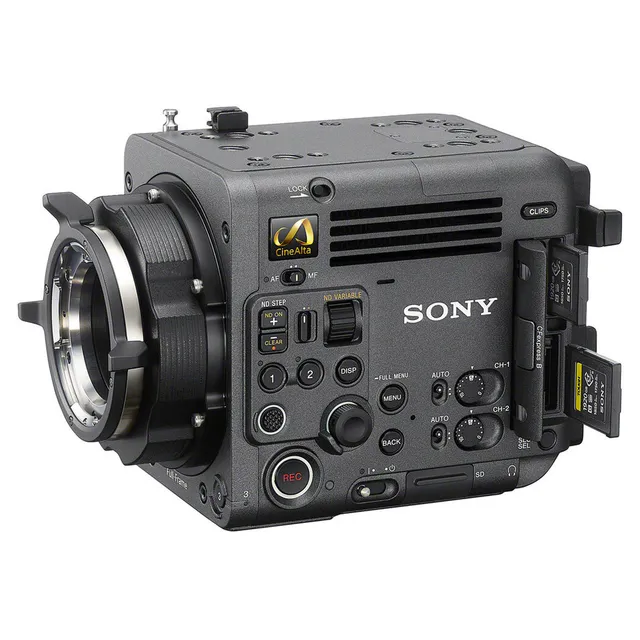
Technical specifications
- Sensor
- Full-Frame CMOS
- Sensor Size
- 35.9 x 24 mm
- Megapixels
- 41.9
- Mount
- Interchangeable Mount
- Max Resolution
- 6K (8632x4856)
- Max Frame Rate
- 120fps @ 4K DCI
- Codec
- XAVC
- Dynamic Range
- 16 Stops
- ISO Range
- ISO 3–3200
- Log / Gamma
- Sony S-Log 3
- Autofocus
- Phase-detect, 627 points
- Stabilization
- Sensor-Shift, 5-Axis
- ND Filter
- 2–7 stop (variable)
- Ports
- 1x BNC (12G-SDI), 1x BNC (3G-SDI), 1x HDMI, 2x XLR 3-Pin Mic/Line, 1x 1/8" / 3.5 mm TRS Stereo Headphone, 1x XLR 4-Pin (11 to 17VDC), 1x BNC (Timecode) Input/Output, 1x BNC (Genlock) Input/Output, 1x 2.5 mm Sub-Mini (LANC, Remote), 1x 1/8" / 3.5 mm (LANC) Control, 1x RJ45 (Ethernet), 1x USB-C (USB 3.2 / 3.1 Gen 2)
- Battery
- V-Mount
- Weight
- 2400g
- Dimensions
- 145.7 x 142.5 x 218.1 mm
- MSRP
- $25,000
- Released
- 2023
Add your voice
Your ratings help other filmmakers choose the right camera.
Own it?
What do you use this for?
Field guide
Overview
The Sony BURANO (MPC-2610) is a powerhouse addition to the CineAlta lineup, designed to bridge the gap between high-end cinema production and the agile, run-and-gun requirements of modern documentary and solo-operator filmmaking. It sits in a unique market position, offering full-frame 8.6K capture in a compact, modular body that feels right at home on a shoulder rig or a gimbal. It is a direct competitor to cameras like the RED V-RAPTOR or the ARRI ALEXA Mini LF, but with the distinct advantage of Sony's E-mount ecosystem and industry-leading autofocus capabilities.
What truly sets the BURANO apart is its internal mechanical ND filter system—a rarity in a full-frame camera of this size—and its dual-mount capability, allowing users to switch between PL and E-mount lenses with ease. The manual highlights its robust internal recording options, including X-OCN (LT) and XAVC H, providing immense flexibility for color grading and post-production workflows. With firmware version 2.0, the camera is even more refined, offering advanced features like subject recognition AF that actually works in a professional cinema context.
This camera is a dream for cinematographers who need to move fast without sacrificing image quality. Whether you are shooting a high-end commercial, a feature documentary, or a corporate interview, the BURANO provides the tools to get the shot. Its modular design, combined with the ability to use both PL and E-mount glass, makes it an incredibly versatile investment for any production house or freelance DP.
Pros & Cons
Pros
Built-in variable ND filter (0.6 to 2.1) is a game-changer for exposure control in changing light without needing external filters.
Dual PL and E-mount flexibility allows for the use of both high-end cinema glass and lightweight, autofocus-capable E-mount lenses.
Internal X-OCN (LT) recording provides excellent dynamic range and color grading flexibility in a manageable file size.
Advanced subject recognition autofocus (Human Eye/Face/Head/Body) brings cinema-grade AF to a professional motion picture camera.
Modular design with a detachable handle and viewfinder makes it easy to strip down for gimbal use or build up for studio work.
Cons
CFexpress Type B cards with a capacity of 2 TB or higher are not supported, which may limit long-form recording sessions.
The camera requires a reboot when switching between certain codecs or imager scan modes, which can interrupt a fast-paced workflow.
X-OCN recording is not supported if HDMI output is enabled, forcing a choice between high-quality internal recording and external monitoring.
The camera is relatively heavy at 2.9 kg with the PL-mount adaptor, which may cause fatigue during long handheld shoots.
The internal fan is a consumable part that requires periodic replacement, adding to long-term maintenance costs.
Best Settings
Narrative Filmmaking
- Shooting Mode: Cine EI
- Codec: X-OCN (LT)
- Base ISO: 800 or 3200 (depending on lighting)
- Color Gamut: S-Gamut3.Cine/SLog3
- Why: This provides the maximum dynamic range and color flexibility for professional color grading in post-production.
Documentary / Run-and-Gun
- Shooting Mode: Custom
- Codec: XAVC H-I HQ
- Base Sensitivity: Low or High
- Look: S-Cinetone
- Why: S-Cinetone offers a beautiful, ready-to-use look that requires minimal grading, perfect for fast turnarounds.
Interview & Talking Head
- Shooting Mode: Custom
- Codec: XAVC-I
- Resolution: 3840x2160P
- Why: XAVC-I is an intra-frame codec that is highly efficient for editing while maintaining excellent image quality for interviews.
Slow Motion
- Shooting Mode: Custom
- Codec: XAVC-I
- Frame Rate: Up to 120 fps (depending on imager scan mode)
- Why: Using XAVC-I ensures high-quality slow motion without the compression artifacts sometimes seen in long-GOP codecs.
Common Issues
Recording Media Errors
- What's happening: The camera displays a "Media Needs to be Formatted" or "Media Error" message.
- Why: The card may be unformatted, formatted in an unsupported specification, or have suffered a file system error.
- Fix: Use the "Format Media" function in the TC/Media menu to perform a full format. If the error persists, the card may be damaged.
- Prevention: Always perform a full format using the camera itself before starting a new shoot.
Overheating Warnings
- What's happening: The camera displays a "Temperature High" warning.
- Why: The internal temperature has exceeded safe operating limits, often due to high ambient temperatures or intensive processing.
- Fix: Turn off the unit immediately and allow it to cool down in a well-ventilated area before resuming operation.
- Prevention: Avoid covering the air inlet/outlet and do not operate the camera in direct sunlight for extended periods.
Autofocus Not Working
- What's happening: Autofocus is unresponsive or unavailable.
- Why: The lens may be set to manual focus, or the camera is in a mode that disables AF (e.g., PL-mount lens attached).
- Fix: Ensure the FOCUS switch on the camera is set to "AF" and the lens focus switch is also set to "AF". Check that the lens is an E-mount lens that supports AF.
- Prevention: Verify lens and camera switch positions before starting a take.
Audio Distortion
- What's happening: Recorded audio sounds distorted or clipped.
- Why: The audio input level is set too high, causing the signal to exceed the camera's headroom.
- Fix: Adjust the audio recording levels using the physical AUDIO LEVEL (CH1/CH2) dials on the side of the camera.
- Prevention: Monitor audio levels on the status screen and keep peaks below the clipping point.
FAQ
- Can the Sony BURANO shoot 8K video?
Yes, the Sony BURANO supports 8K recording. You can record in 8K using X-OCN or XAVC H formats, provided the system frequency is set to 29.97 or lower.
- Does the Sony BURANO have built-in ND filters?
Yes, the Sony BURANO features a built-in, linearly variable ND filter. It ranges from 0.6 (1/4) to 2.1 (1/128) density, allowing for precise exposure control.
- Can I use PL-mount lenses on the Sony BURANO?
Yes, the Sony BURANO comes with a PL-mount adaptor. You can remove this adaptor to use E-mount lenses, making the camera highly versatile for different lens kits.
- What memory cards does the Sony BURANO use?
The Sony BURANO uses CFexpress Type B memory cards for primary recording. It also has a utility SD card slot used for proxy recording, settings, and software updates.
- Is the Sony BURANO compatible with autofocus lenses?
Yes, the Sony BURANO supports autofocus when using E-mount lenses. It features advanced subject recognition AF, including human eye, face, head, and body detection.
- Does the Sony BURANO support X-OCN recording?
Yes, the Sony BURANO supports X-OCN (LT) recording. Note that X-OCN can only be selected when the camera is in Cine EI mode.
- Can I record proxy files on the Sony BURANO?
Yes, the Sony BURANO supports simultaneous proxy recording to an SD card. You must insert an SD card into the Utility SD card slot and enable Proxy Rec in the Project menu.
- What is the maximum frame rate of the Sony BURANO?
The maximum frame rate depends on the recording format and imager scan mode. In certain modes, it can reach up to 240 fps for slow-motion capture.
Recommended Accessories
- ARRI PL-Mount Lenses — leverage the interchangeable mount for top-tier cinema glass. Shop on Amazon
- Anton/Bauer Titon Micro V-Mount Batteries — compact, high-capacity power for the V-mount system. Shop on Amazon
- CFexpress Type B Cards — required for high-bitrate 6K recording and fast offloads. Shop on Amazon
- Tilta Full Camera Cage — essential for mounting accessories and protecting the camera body. Shop on Amazon
- SmallRig Burano Cage — adds mounting points and protection for accessories. Shop on Amazon
- Tilta Nucleus-M — wireless follow focus for precise manual focus control. Shop on Amazon
- IDX DUO-C98 V-Mount Battery — compact, high-capacity power for extended shoots. Shop on Amazon
- Sony FE 24-70mm f/2.8 GM II — versatile zoom for run-and-gun with AF. Shop on Amazon
Related comparisons
The Burano offers cutting-edge 8.6K resolution and 5-axis IBIS, while the FX9 remains a cost-effective 4K workhorse.
See full comparison Burano vs VENICE 2The Burano excels for agile, solo operation with IBIS and AF; the VENICE 2 remains the gold standard for high-end, controlled cinema productions.
See full comparison